
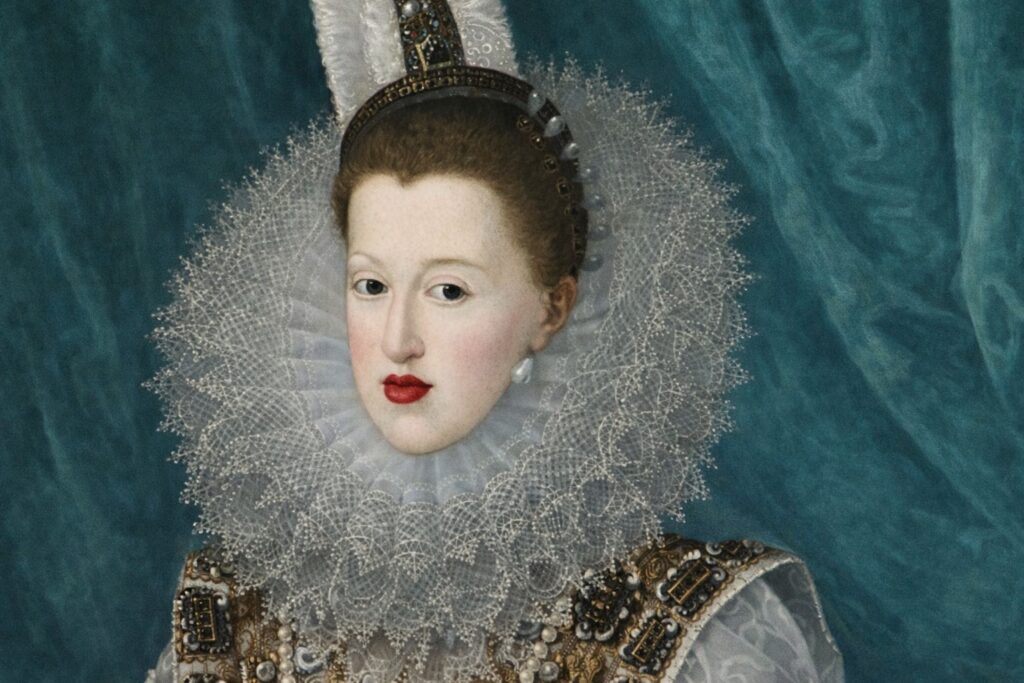
At the height of the Spanish Empire, Margarita of Austria proved that power did not always reside where it was supposed to. In the court of Philip III, three figures shared the stage in a way that no political treatise could have scripted better: a brilliant queen, a passive king,
and a greedy royal favourite
Margarita of Austria: the queen who arrived as a stranger
Margarita of Austria-Styria was fourteen years old when she arrived in Spain in 1599. She did not speak the language, she had no established allies, and she was marrying a king who preferred to delegate. Within a few years, she had become the real political backbone of the Crown.
She learned quickly that authority does not require a dictionary — it requires determination. While Philip III floated between distractions, Margarita built influence through presence, strategic alliances, and an image carefully constructed for maximum effect. Nearly three hundred chronicles celebrated her arrival and early years as queen. She was, in today’s terms, an international celebrity — and she knew exactly how to use it.
The man who confused the State with his personal business
Margarita of Austria and the Duque of Lerma
He saw her as a threat. He was right.
Francisco Gómez de Sandoval y Rojas, Duke of Lerma, was Spain’s first true prime minister — and its most self-serving. He sold Italian noble titles, kept a parallel set of accounts labelled “secret expenses”, and relocated the royal court to Valladolid, where he conveniently already owned properties. He also had Margarita’s correspondence intercepted and replaced her inner circle with his own people.
A queen who governed in silence
From her base at the Monastery of the Descalzas Reales in Madrid — still standing today and one of the city’s most remarkable hidden gems — Margarita built a network of support that slowly eroded Lerma’s grip on power. In 1606 she formally denounced his corruption to the king.
She died in 1611, aged just twenty-six, after childbirth. She never saw Lerma’s final fall. But she had prepared the ground.
Where to follow her story in Madrid today
If you walk through the Madrid of the Habsburgs, you walk through her world. The Monastery of the Descalzas Reales, the old Royal Alcázar site near today’s Palacio Real, the streets of the Austria quarter — these are the spaces where this story unfolded.
Our walking tours of Habsburg Madrid bring these figures back to life. Because history, when told in the right place, is never abstract.