
Attending Palm Sunday mass at Las Descalzas Reales and finding yourself next to the King and Queen of Belgium — as ordinary worshippers — is not something that happens every day. But in Madrid, a city given to these quiet miracles, it is not impossible either.
A historical thread spanning five centuries
Days earlier I had written about Juana de Austria y Isabel Clara Eugenia — aunt and niece, both tied to this monastery and to the Spanish Netherlands of the 16th century, the territory that includes present-day Belgium.
Yesterday, that historical thread became a bridge across centuries, made visible by the presence of King Philippe and Queen Mathilde of Belgium.
The discretion of those who know how to simply be
Seated in the front row before the tomb of Juana de Austria, the sovereigns attended mass with quiet dignity, side by side with other worshippers. No extraordinary gestures, no imposed distance — only the sobriety of those who know how to simply be.
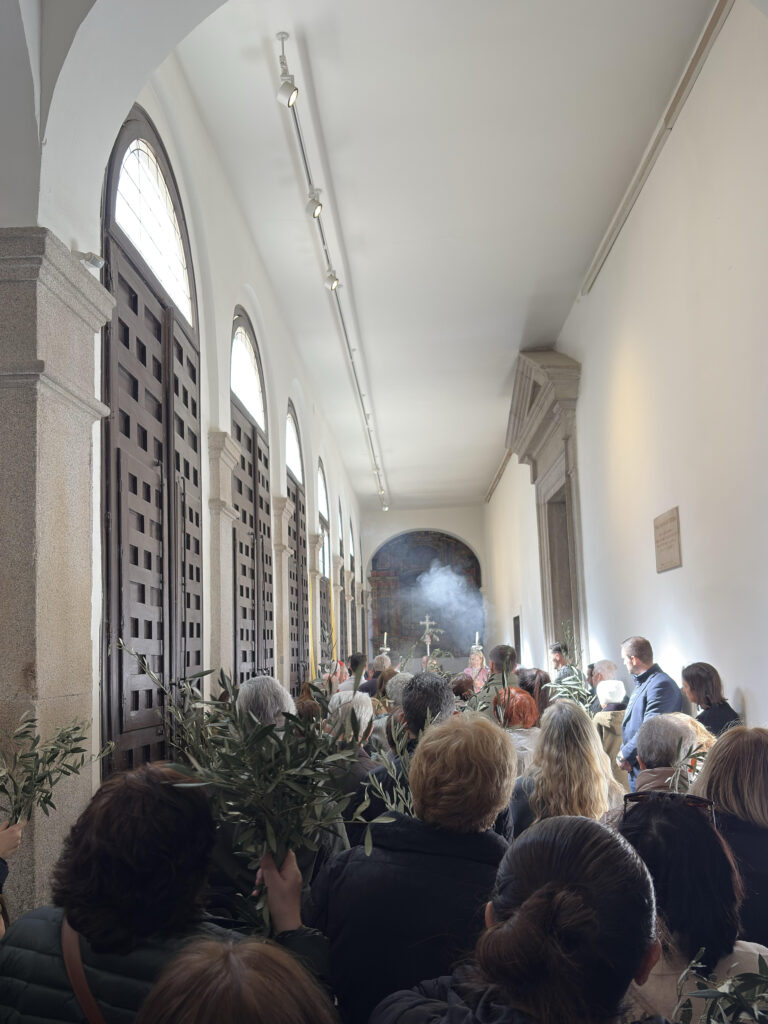
They might have gone unnoticed, had it not been for the blessing of the olive branches. As is tradition, the congregation moved toward the cloister for the procession. It was then that the closeness became apparent. I stepped aside to let Queen Mathilde pass — she waited with calm courtesy, unhurried and unassuming. Her height, close to six feet, and an unaffected elegance set her apart without any need for protocol. The King took his place a few steps ahead.
A celebration between liturgy and Renaissance architecture
The celebration was sung by the cloistered Poor Clare nuns. The church, Renaissance in design, austere on its facade and rich within, rose beneath its barrel vault with lunettes — attributed to Juan Bautista de Toledo, the same architect who began the Monastery of El Escorial.
The mass was celebrated by the Cardinal Archbishop Emeritus of Madrid, Carlos Osoro, vested in a red chasuble — the liturgical colour of Palm Sunday, symbol of the Passion. He wore the mitre during the solemn moments, alternating with the zucchetto, as ceremonial dictates. There was no ostentation, only continuity: liturgy and history are not improvised.
The granite courtyard and the atmosphere of incense
From the original palace, the entrance hall and granite column courtyard still remain, through which the congregation processed. Light descended from above, filtered by incense that traced in the air a suspended, almost unreal atmosphere.
For a moment, the 16th and 21st centuries joined hands without fanfare: imperial Spain, the Low Countries, the court, the faith… and two contemporary monarchs walking, simply, among the rest. And no one seemed surprised.